Experimental Typst web edition · Veto chapter pilot
1 Axions and Axion-Like Particles
1.1 Motivation and Scope
The QCD axion is a hypothetical pseudoscalar particle predicted by the most widely studied dynamical solution to the strong problem. Its small mass and weak interactions also make it a viable cold-dark-matter candidate over broad, cosmology-dependent regions of parameter space. Axion-like particles (ALPs) share similar interactions but need not solve the strong problem and do not obey the QCD relation between mass and couplings. Both classes of particles arise in extensions of the Standard Model and motivate a diverse experimental program [8–10].
This chapter introduces only the physics required to place solar helioscopes in that program. It summarizes the strong problem, the Peccei–Quinn mechanism, the interactions most relevant to experiments, and the principal cosmological and astrophysical motivations. The emphasis is on the axion-photon coupling because it governs both solar production through the Primakoff process and coherent conversion in a laboratory magnetic field. The corresponding solar spectra, conversion probability, coherence conditions, buffer-gas operation, and helioscope figure of merit are developed in the next chapter.
The observable solar signal is the product of the axion flux, the probability of conversion in the magnet, and the detector acceptance. Even a large incident flux can therefore produce only a few detected X rays. For IAXO and BabyIAXO, the detector must combine efficient, stable operation in the region with strong rejection of instrumental and environmental backgrounds.
1.2 The Strong CP Problem and the QCD Axion
The most general quantum chromodynamics (QCD) Lagrangian contains a term that violates parity and ,
(1.1)
Here, is the gluon field-strength tensor, is its dual, is the strong coupling, and is the quark mass matrix. The physical angle combines the bare QCD angle with a phase from the quark masses. This source of strong-interaction violation is distinct from the observed Cabibbo–Kobayashi–Maskawa phase in the weak sector. Although setting to zero is compatible with observation, the Standard Model contains no symmetry that requires this value once the quark masses are complex. The difficulty is therefore not an inconsistency of QCD but the unexplained hierarchy between the allowed natural scale of the parameter and its experimental upper bound.
The neutron electric dipole moment (nEDM) provides the most direct constraint on . The 2020 measurement, which remained the most stringent direct limit as of September 2026, gives [18]
(1.2)
Hadronic calculations place at order , with a coefficient that depends on the calculation method [10, 19, 20]. Equation (1.2) therefore requires . Explaining why a dimensionless parameter that could naturally be of order unity is so small constitutes the strong problem. Other proposed solutions impose fundamental symmetry or modify the light-quark sector, but they require additional model structure. The Peccei–Quinn (PQ) mechanism is particularly economical because the same dynamics that removes predicts a particle that can be searched for experimentally [8, 10].
The PQ mechanism promotes this fixed angle to a dynamical degree of freedom [1, 2]. A global symmetry is spontaneously broken at a scale , producing a pseudo-Nambu–Goldstone field . Its QCD anomaly gives the effective interaction
(1.3)
Nonperturbative QCD generates a potential whose minimum satisfies . The effective strong angle then vanishes dynamically, while fluctuations about the minimum constitute the axion [3, 4]. This sign convention is consistent with Equation (1.1); reversing the definition of would change both axion signs without changing observables.
The same QCD dynamics fixes the axion mass through the topological susceptibility. Modern chiral and lattice calculations give [21, 22]
(1.4)
Consequently, a larger PQ scale produces a lighter and more weakly coupled axion. Axions with near the electroweak scale were excluded by laboratory measurements, whereas invisible-axion models with remain viable. This inverse relation between mass, interaction strength, and the symmetry-breaking scale explains why viable axions are challenging to detect and why large magnetic volumes, long exposures, and low-background detectors are required.
1.3 Interactions and Axion-Like Particles
The gluonic interaction in Equation (1.3) is essential to the solution of the strong problem, but couplings to photons, electrons, and nucleons depend on the ultraviolet realization of the PQ symmetry. The photon interaction can be written as
(1.5)
Here, is the electromagnetic-to-color anomaly ratio of the PQ current, while and are the electromagnetic field-strength tensor and its dual. The second term includes the model-independent contribution from mixing with neutral mesons [10, 21]. For QCD axions, Eqs. Equation (1.4) and Equation (1.5) produce an approximately linear band in the plane rather than two independent parameters.
KSVZ and DFSZ constructions provide common reference models [23–26]. In the simplest KSVZ model, the anomaly is generated by a new heavy quark; an electrically neutral heavy quark gives . In DFSZ models, Standard Model fermions couple through an extended Higgs sector, with in the commonly used benchmark. These values are useful reference lines but do not encompass all viable QCD-axion couplings. The electron coupling is defined here by
(1.6)
Thus is dimensionless, whereas has dimensions of inverse energy. The coefficient conventionally appears in the derivative interaction . The electron equations of motion relate it to the pseudoscalar form above; a change of operator basis must also account consistently for the anomalous photon term [8, 27]. Electron and nucleon couplings control additional solar production channels, stellar energy loss, and searches through interactions with matter. Their model dependence is kept explicit when reporting limits on production–detection coupling products.
The interaction in Equation (1.5) permits several physically distinct processes. In the microscopic Coulomb field of a charged particle, photon–axion scattering is the Primakoff process. In a macroscopic transverse magnetic field, axion and photon states instead undergo coherent mixing, which can be described as oscillation between the two states. A material medium changes the photon dispersion relation and can restore phase matching; it does not simply supply a second real photon. Spontaneous decay is also allowed. In natural units, , its decay width and lifetime are
(1.7)
The strong inverse dependence on both mass and coupling makes this decay extraordinarily slow for the light, weakly coupled particles relevant to helioscopes. For example, and give . The decay is therefore negligible on laboratory, solar-system, and cosmological timescales for this benchmark; coherent conversion in an external field is the experimentally relevant process [10, 28, 29].
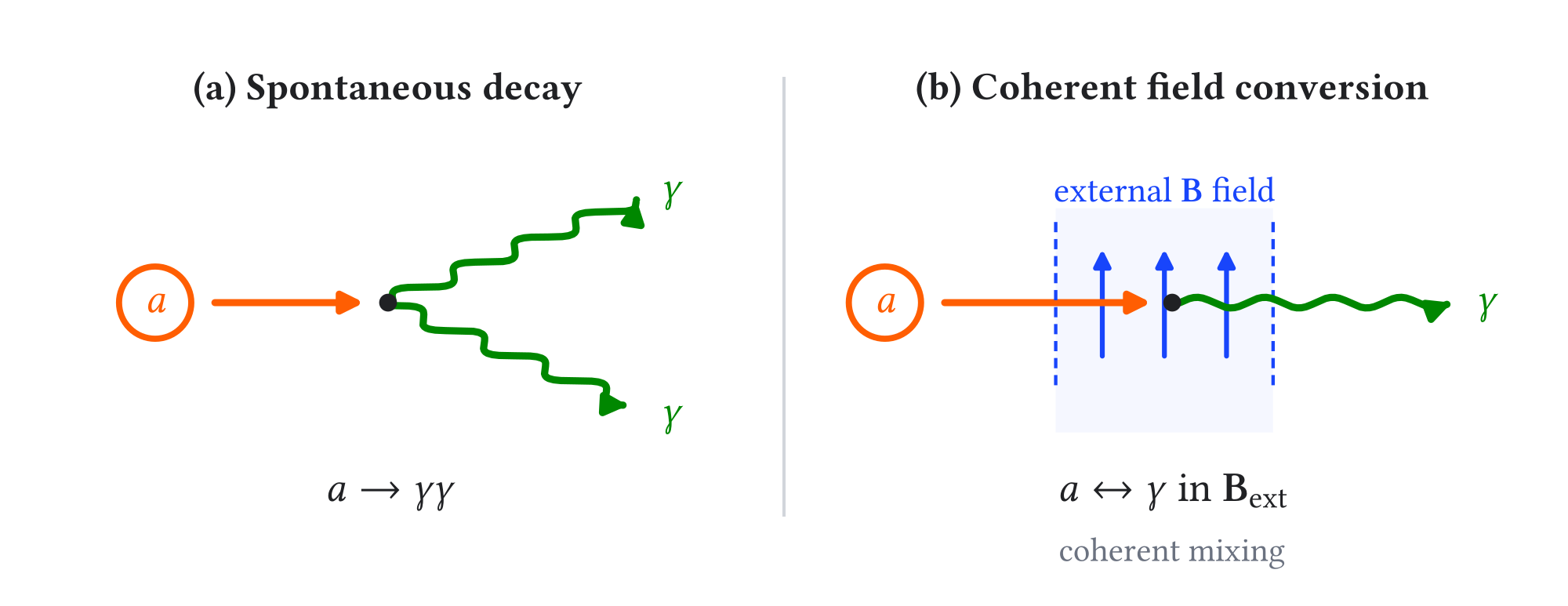
An ALP is a light pseudoscalar with axion-like interactions but without the strict QCD relation between mass and couplings. Such fields can result from approximate global symmetries, hidden sectors, or string compactifications, and they need not solve the strong problem [30–33]. Experiments therefore report both QCD-axion interpretations, represented by a model band, and more general ALP limits in which and are independent. This broader interpretation is useful for helioscopes because the same detector can test a QCD axion and any sufficiently light ALP produced by the same solar processes. Only the mapping from the measured coupling limit to an underlying particle model changes.
1.4 Cosmological and Astrophysical Context
Axions can form cold dark matter through nonthermal production. The canonical mechanism is vacuum misalignment: after PQ symmetry breaking, the axion field is generally displaced from the minimum of its potential. When the expansion rate falls to approximately , the field begins coherent oscillations whose energy density subsequently redshifts approximately as nonrelativistic matter [9, 34].
The predicted abundance depends strongly on the cosmological history. If PQ symmetry breaking occurs before inflation and is not restored afterward, the observable Universe inherits one initial misalignment angle, and isocurvature constraints connect the model to the scale of inflation. If it occurs after inflation, different regions begin with different angles, while axion strings and domain walls can contribute to the abundance. For this reason, cosmology does not select one unique axion mass or require axions to constitute all dark matter. Haloscope interpretations also depend on the assumed local halo density and velocity distribution, whereas helioscopes do not depend on the cosmological axion abundance. The distinction is important when comparing exclusion plots: a haloscope limit can weaken if axions are only a subcomponent of the halo, while a helioscope limit continues to constrain the relevant solar-production and photon-conversion couplings.
Thermally produced axions provide a separate cosmological probe. If sufficiently light and long-lived, they contribute a hot relic component that affects the cosmic microwave background and the growth of large-scale structure. The resulting constraints depend on the thermal history, the relevant axion couplings, and the cosmological data combination, so they are best stated as model-dependent limits rather than as a single universal mass bound [10, 35].
Stellar environments constrain weakly coupled particles because axions can escape and carry away energy. The Primakoff process in horizontal-branch stars and the Sun probes , while red giants, white dwarfs, supernovae, and neutron stars test complementary electron and nucleon couplings [35, 36]. These bounds follow from agreement between observed stellar populations or evolution and models that include an additional energy-loss channel. Their reliability depends on the object and observable, so limits from several systems should not be treated as statistically interchangeable. Some stellar observations have been interpreted as possible cooling anomalies, but their present significance does not constitute evidence for axions. They instead define motivated targets that should be tested with controlled experiments. Solar helioscopes are especially valuable in this respect because they search directly for particles emitted by the Sun without requiring axions to be Galactic dark matter. Their interpretation still relies on solar modeling, but the solar interior is constrained by helioseismology and neutrino measurements, and the signal can be modulated experimentally by alternating between tracking and nontracking periods.
1.5 Search Landscape and the Role of Helioscopes
Axion experiments exploit complementary assumptions and interactions [10, 37, 38]. Figure 1.2 gives a selective orientation to the principal photon-coupling searches relevant here rather than an exhaustive compilation.
![Figure 1.2: Selective overview of the axion-photon parameter space. The digitized CAST, globular-cluster, ALPS I, and haloscope boundaries and the design projections use the checksum-verified AxionLimits snapshot [ 39 ]; the underlying CAST, stellar, and ALPS I results are given in Refs. [ 40 – 42 ]. The added ALPS II segment shows its reported 95% low-mass limit from the 2024 science campaign, only for 𝑚 𝑎 ≲ 0.1 meV [ 43 ]. Solid boundaries denote observed limits; unfilled dashed curves denote design projections, including the separate ALPS II design target. The hatched model band and KSVZ/DFSZ lines use the central constants in Eqs. Equation (1.4) and Equation (1.5) . Haloscope limits are shown for a local dark-matter density of 𝜌 DM = 0.45 GeV cm − 3 and therefore assume a Galactic axion population. Stellar and helioscope limits do not require axions to constitute the local dark matter.](assets/2ea0f0c70bec32c4d8b84c59.png)
The boundaries in Figure 1.2 have different statistical and physical interpretations. CAST reports a 95% Bayesian upper limit with a prior uniform in nonnegative , using a solar Primakoff flux [40]. The globular-cluster bound uses the ratio of asymptotic-giant-branch to horizontal-branch populations and depends on the treatment of convective mixing [41]. The haloscope curve is an envelope of searches with distinct mass coverage and analysis assumptions, rather than a joint likelihood [10, 39]. The digitized curves are approximate representations of those results; in particular, the published low-mass CAST limit is . The BabyIAXO and IAXO curves retain their published design assumptions [13, 14].
Haloscopes use a magnetic field and a resonant or broadband electromagnetic structure to convert nonrelativistic Galactic axions into photons. They have reached benchmark QCD-axion sensitivity in selected mass regions, but their interpretation assumes a local dark-matter population. The broader program includes microwave cavities, dielectric structures, lumped-element circuits, plasma concepts, and quantum sensors. Because resonant instruments cover a limited frequency interval at one time, much of this program proceeds through systematic scans across axion mass.
Light-shining-through-wall experiments generate ALPs from a laser in one magnetic region, block the photons, and search for regenerated photons after a second magnetic region. This is a laboratory-only test that is independent of astrophysical-source and cosmological-abundance assumptions, although its production-and-regeneration probability scales as . The ALPS II campaign of February–May 2024 found no signal and set a 95% upper limit of for pseudoscalar masses below approximately [43]. Its projected reach assumes the upgraded optical configuration and is shown separately from this measurement.
Other searches target axion interactions with matter. Low-threshold detectors can search for axion absorption through electron couplings. CASPEr uses nuclear magnetic resonance and spin-precession observables to probe oscillating axion-induced moments and fields, whereas ARIADNE searches for an axion-mediated spin-dependent force [37, 44]. Together, these approaches retain sensitivity when the photon coupling is suppressed. No single method covers the full parameter space: resonant dark-matter searches provide high sensitivity over narrow mass intervals, laboratory production minimizes source assumptions, and helioscopes combine broad mass acceptance with sensitivity to solar production.
Helioscopes search for relativistic axions continuously produced in the Sun, using coherent conversion in a transverse laboratory magnetic field. The observable is a tracking-correlated excess of focused X rays, independent of the local dark-matter density. Optics reduce the detector area collecting background while preserving the magnet aperture, linking the three principal elements of the IAXO design [45]. The next chapter develops the solar spectra, conversion probability, and exposure requirements for this search.